
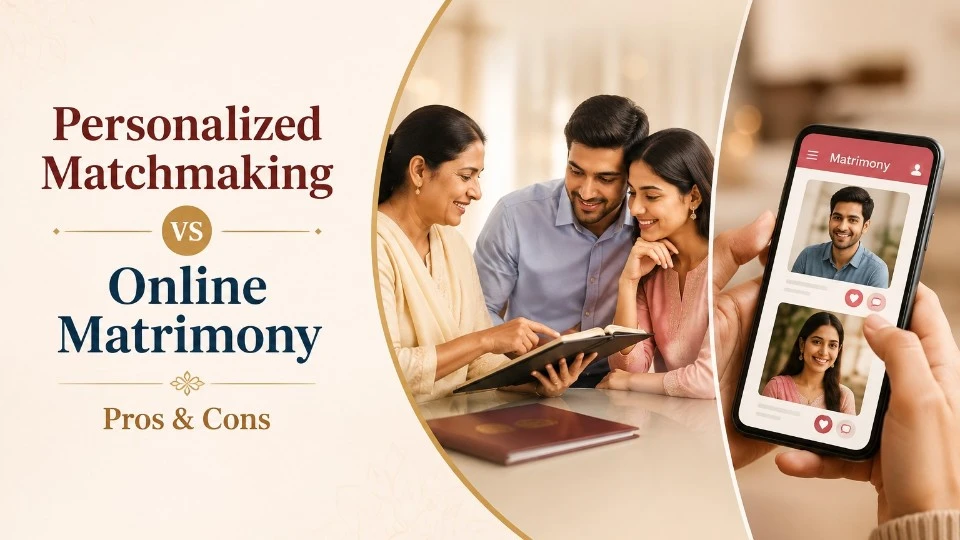
Finding a life partner has never come with more options – or more noise. Matrimonial websites promise millions of profiles at your fingertips. Dating apps reduce the search to a swipe. And somewhere in between, personalized matchmaking has carved out a different path: one built on curated introductions, human judgment, and real conversations instead of endless scrolling.
If you’ve typed “matchmaking service vs. dating app” into a search bar recently, you’re not alone. The two models solve the same problem in almost opposite ways, and the right choice depends less on which one is “better” and more on what kind of search you actually want to go through.
This guide breaks down how personalized matchmaking differs from online matrimony, the real pros and cons of each, and how to figure out which approach fits your life right now.
The Rise of Online Matrimony and Dating Apps
Over the last two decades, online matrimonial sites and dating apps have become most people’s default starting point. They’re free or low-cost, available 24/7, and give you access to a huge volume of profiles in minutes. For many, that scale feels like an advantage – more profiles should mean more chances.
In practice, though, scale creates its own problem: volume without context. You’re left to sift through hundreds of profiles, guess at compatibility from a few photos and a bio, and manage your own screening, scheduling, and follow-up. The platform connects you to people; it doesn’t help you evaluate them.
That gap is exactly what personalized matchmaking is designed to close.
What Is Personalized Matchmaking?
Personalized matchmaking is an advisor-led approach to finding a partner. Instead of browsing an open database, you work with a matchmaker or advisor who gets to know your background, values, lifestyle, and what you’re actually looking for – then introduces you to a small number of people who are genuinely aligned, rather than everyone who technically fits a filter.
As we like to put it at Vats:
“We do not overwhelm you with thousands of profiles. We curate considered introductions…”
That’s the core difference. A matchmaking service benefits you by doing the filtering work upfront – verifying backgrounds, understanding intent, and using human judgment to assess compatibility in ways an algorithm can’t. You’re not managing a pipeline of strangers; you’re having a small number of meaningful conversations with people who’ve already been vetted for fit.
Neither model is universally “right” – they’re built for different priorities.
Pros and Cons of Online Matrimonial Platforms
Pros:
- Large pool of profiles to browse at your own pace
- Low cost of entry, often free to start
- Full control over who you message and when
- Familiar, app-based experience
Cons:
- You do all the screening, scheduling, and vetting yourself
- Profile accuracy and intent can be hard to verify
- Can be time-consuming and emotionally draining at scale
- Your profile is visible to a broad, often public audience
- No one is invested in your specific outcome
Pros and Cons of Personalized Matchmaking
Pros:
- Curated introductions based on real compatibility, not just filters
- An advisor to guide you through the process and give honest feedback
- Greater privacy – no public-facing profile
- Less time wasted on mismatched conversations
- Support with the harder parts: feedback after a match, navigating family involvement, managing expectations
Cons:
- Typically involves a fee for a consultative service
- Fewer total introductions, since each one is curated rather than open-ended
- Requires some trust in your advisor’s judgment
- Less “self-directed” than browsing on your own
How to Decide Which Model Is Right for You
A few honest questions can point you toward the right approach:
How much time do you actually have? If you’re busy with work, family, or other commitments, browsing hundreds of profiles and managing your own outreach can feel like a second job. Personalized matchmaking shifts that workload to someone else.
Do you want guidance, or do you want control? Some people want to make every decision themselves, start to finish. Others want a second, experienced opinion – someone who can say “this seems like a good fit, here’s why” or gently flag a red flag you might miss on your own. If you’d value that kind of handholding, matchmaking tends to be the better fit.
How specific are your preferences? If you’re looking for a partner who shares a particular community, cultural background, or family expectations – for example, NRI singles balancing life abroad with family ties at home – a general platform’s filters often aren’t precise enough. An advisor who understands that context can identify fit in ways a keyword search can’t.
How much do you value privacy? On open platforms, your profile is visible to anyone who searches. Personalized matchmaking keeps your search discreet – no public listing, no unwanted messages, no awkward run-ins with acquaintances scrolling the same site.
Why People Choose Vats
At Vats, personalized matchmaking means more than an introduction – it means an advisor who stays involved throughout your search. We verify profiles, take time to understand what actually matters to you, and introduce you only to people we believe are worth your time. No public profile, no inbox full of unfiltered messages – just trusted introductions and honest support along the way.
Curious how the process actually works? Take a look at How We Work for a step-by-step breakdown, or read more About Us to understand the values – trust, privacy, and genuine care – behind every match we make.
Frequently Asked Questions
Ans. Not at all. Many clients come to matchmaking first, specifically because they want a more focused, private process from the start rather than sorting through open platforms.
Ans. Generally, yes – matchmaking is a paid, consultative service, while most apps are free or low-cost. The trade-off is time and effort: you’re paying for curation, screening, and guidance rather than doing it yourself.
Ans. Some people do. But many find that once they experience curated, advisor-guided introductions, the open-browsing model starts to feel like unnecessary noise.